






Track the engineering and fiber network
Centralize surveys, optical fiber layouts, permits and evidence of the construction process.
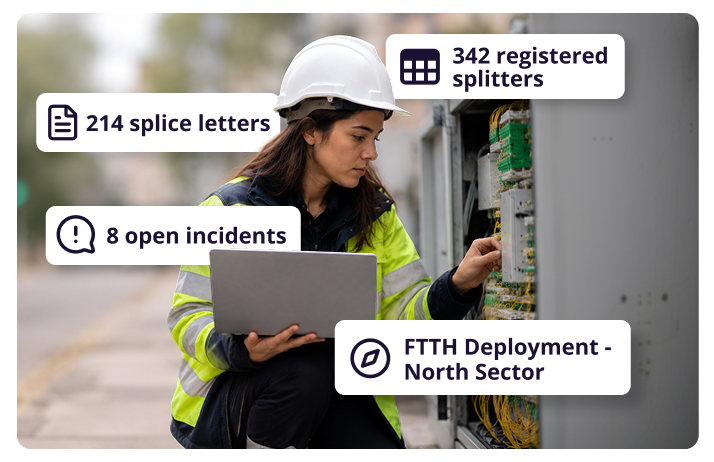
Manage staking/field-survey visits, CTOs, splitters and splice boxes on top of Google Maps in one place.
Control technical documentation for the network, closing tasks and construction deliverables.
At every stage and with external companies
Share validated documentation with contractors and subcontractors with full traceability.
Ensure the latest version of the documentation is always available.
Receive automatic notices when changes, permits or deliveries occur.
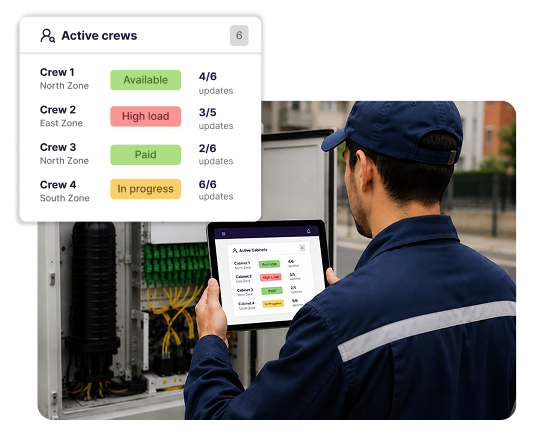
Coordinate installations, surveys and field actions
Assign tasks to your field teams according to area, workload and availability.
Control project progress and each technician’s workload without duplicating effort.
Streamline coordination and validate information in a clear, simple and efficient way.
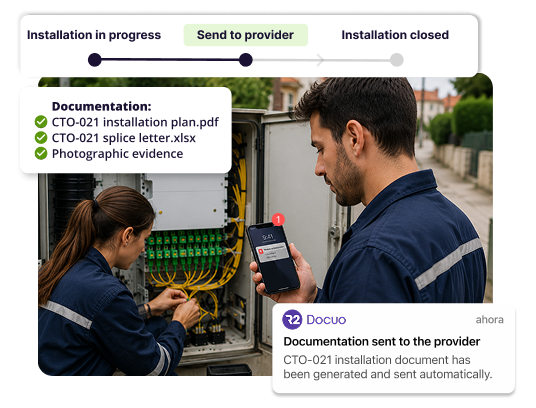
For operators and clients
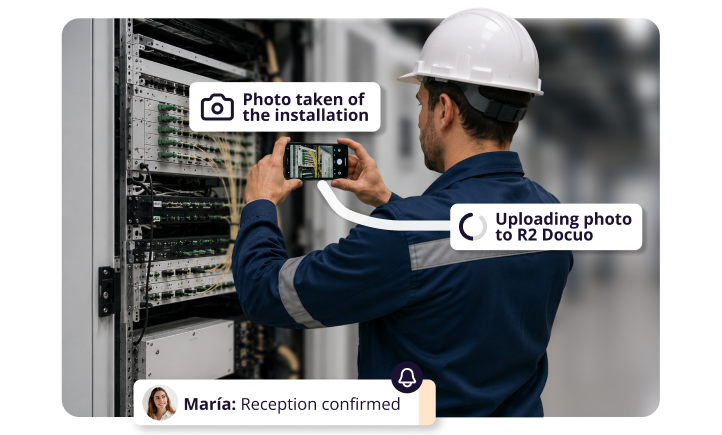
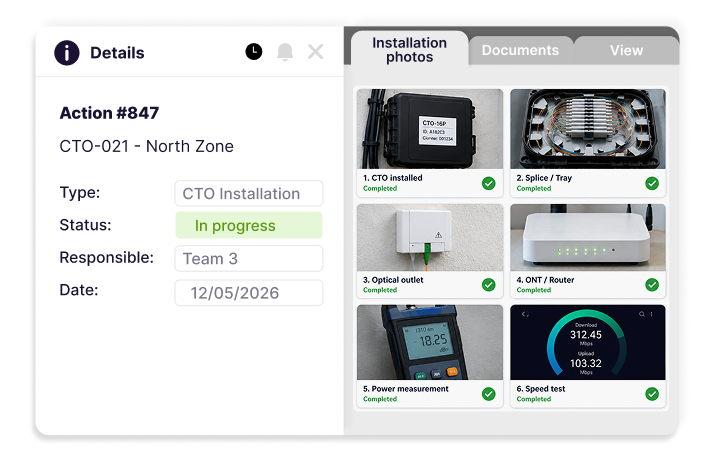
Technicians can upload field data and link them directly to each action.
Generate technical reports with installations, certifications and verifications.
Export documentation to clients or operators, including plans, evidence and technical deliveries.
We work with you to make your rollouts easier and more efficient. We accompany R2 Docuo implementation and support your team in our experience with hundreds of companies.

Control and tracking of deliveries, efficient allocation of tasks, digital documentation, optimization of resources and greater accuracy in the deployment processes of FTTH connections.
By allowing an equitable distribution of tasks, real-time tracking of the status of each job and effective communication between the teams involved.
Automatically, the software considers the availability and workload of each technician, assigns them and provides real-time tracking of assigned letters for better traceability and management.
There is nothing that resists it: information, deliveries made, job status, uploaded and validated documentation, resource allocation, traceability of splice letters, technical review of drawings…
The main advantage is the automation and centralization of processes, which reduces the possibility of errors, speeds up delivery times and improves overall efficiency in the deployment of FTTH connections.
The implementation time varies depending on the size and complexity of the project, but is usually relatively fast, allowing a go-live, on average, in 4 weeks.
It is the inspection and collection of data in the field to plan a telecommunications project.
This is the official authorization to carry out specific work, such as construction or network installation.
Detailed network deployment planning, including locations, equipment and routes.
Direct fiber optic connection from the central point to the customer’s home.
A home that has been connected and activated on the FTTH network.
The main fiber pathways (feeder) and secondary (distribution) networks that connect homes and businesses.
Construction work, such as excavation or duct installation, to facilitate fiber deployment.
Companies specializing in construction work, often contracted for fiber deployment.
Cable composed of optical fibers that transmit data at high speeds.
Optical Network Terminal (ONT) device that converts fiber optic signals into electrical signals for use in the home.
Cards or tools used to join or connect two fiber optic ends.
A fiber optic-based telecommunications network that reaches customers’ homes directly.
Passive optical network that uses splitters to distribute fiber optic signals to multiple homes, with no active components between the central point and the end user.

