



Audit Management Software: The 6 Best for Certification and Inspection Bodies in 2026

Audit management software is the application a certification body, an inspection body or an audit firm uses to plan its audits, assign competent auditors to each one, collect evidence in the field, follow nonconformities through to closure and issue reports and certificates. It replaces the usual trio of spreadsheet, email and shared folders with a single file per client that covers the whole certification cycle. There is no single best audit management software for every body: there is a best one for your type of audit, your number of clients and your market.
- Certification and inspection in Spain, with heavy documentation, e-signature and security requirements (ENS): R2 Docuo
- Certification body that wants a product built specifically for ISO/IEC 17021-1 with a published per-client price: TIC OS
- European certification or inspection body looking for a specialised product with top-tier clients: Zertic
- International certification group, scheme owner or accreditation body: Intact
- Agri-food certification and regulatory councils: CertiApp
- Control body (OCA) that needs a full ERP, from quote to invoice: Selenne ERP for OCA
This comparison is written for those who audit and certify third parties: system and product certification bodies, inspection and control bodies, and audit firms. It does not cover the quality software a company uses to run its own ISO system, nor financial, statutory or IT audit tools, which solve other problems and serve another market. If you first want to review the process (types of audit, the three-year certification cycle, nonconformities), start with our guide on how audit management works. We will not repeat it here: here we choose a tool.
The right audit management software depends on your type of audit, your number of clients and your market, not on a universal ranking.
In this comparison you will find a table with the six tools, the criteria we used to evaluate them, each tool’s profile with its weak points, the ten functions audit management software must have, when you do not need one, what Spanish regulations require, how to use it from an AI assistant and how much it costs.
Quick comparison: 6 tools at a glance
Prices, languages, certifications and ratings checked on 10 November 2026 on each vendor’s official pages, on G2 and on Capterra. “No reviews” means the product has no listing or zero published reviews; we explain why in the methodology section. Prices change: check them before deciding.
| Tool | Best for | Published entry price | Reviews (G2 · Capterra) | Spanish | Security and data |
|---|---|---|---|---|---|
| R2 Docuo | Certification and inspection in Spain, with a full document file and e-signature | From €99/month, custom pricing | G2 4.5 · 99 reviews (ECM category) | Native | ISO 27001 · ENS High category · data in Spain |
| TIC OS | System, product and inspection certification bodies that want a specialised product | €5/certified client/month (Standard plan) | No reviews | Interface and client portal | ISO 27001 · data in the EU |
| Zertic | Certification, inspection and accreditation in Europe | No published pricing | No reviews | Website in Spanish | States GDPR and ISO 27001 compliance · hosting not published |
| Intact | International certification groups, scheme owners and accreditation bodies | No published pricing | G2 4.2 · 3 · Capterra 3.5 · 2 (sample too small) | Website only in English and German | Not published |
| CertiApp | Agri-food certification, regulatory councils and inspection | No published pricing | No reviews | Native | Not published |
| Selenne ERP for OCA | Control bodies: OCA, vehicle inspection and testing | No published pricing (fixed cost) | No reviews | Native | Not published |
How we evaluated
We compared each tool on eight criteria: the type of body it is designed for (system certification, product certification or inspection), how much of the certification cycle set out in ISO/IEC 17021-1 it covers, field work from a mobile device, client portal, published entry price, verified reviews, Spanish language support, and where data is hosted and with which security certifications.
The information comes from each vendor’s public documentation (product, pricing and security) and from G2 and Capterra listings. When a figure is not published, we say so instead of guessing.
Why there are hardly any reviews. In most software comparisons, G2 ratings order the list. Here they cannot, and that is useful information in itself: G2’s Audit Management category is designed for companies’ internal audit and expressly excludes external certification audits. Software for certification bodies is a small, specialised market with few, very large clients, and almost none of its vendors has public reviews. Be wary of any list that ranks this market by stars.
In software for certification bodies, G2 stars cannot rank anything: almost no vendor has public reviews.
And let us be clear: we are R2 Docuo. We publish this comparison, so we have an obvious interest in you choosing us. To help you weigh that: our G2 reviews are in the Enterprise Content Management category, not in an audit category, and we cite them that way; every profile, ours included, ends with a “Where it falls short” section; and several lines of the opening list go to others. We have tried to make every claim something you can check for yourself.
The 6 tools, one by one
1. R2 Docuo
- Best for: certification and inspection bodies working in Spain that manage a lot of documentation per client and need e-signature and the security guarantees their own clients ask for.
- Price: from €99/month, with custom pricing depending on the project.
- G2: 4.5/5 from 99 reviews in the Enterprise Content Management category · Fastest Implementation and Best Estimated ROI (Enterprise segment, summer 2026) · Users Most Likely To Recommend Enterprise (fall 2026).
- Security and data: ISO 27001 · ENS High category · data of Spanish clients is hosted in Spain.
- What it covers: quotes, visit planning and auditor assignment, field forms with evidence, client portal, nonconformities and corrective actions, reports and certificates generated from Word templates with e-signature, expiry alerts. MCP server to use it from Claude, ChatGPT or Gemini.
- Clients in the sector: SGS · Applus+ · TÜV SÜD.
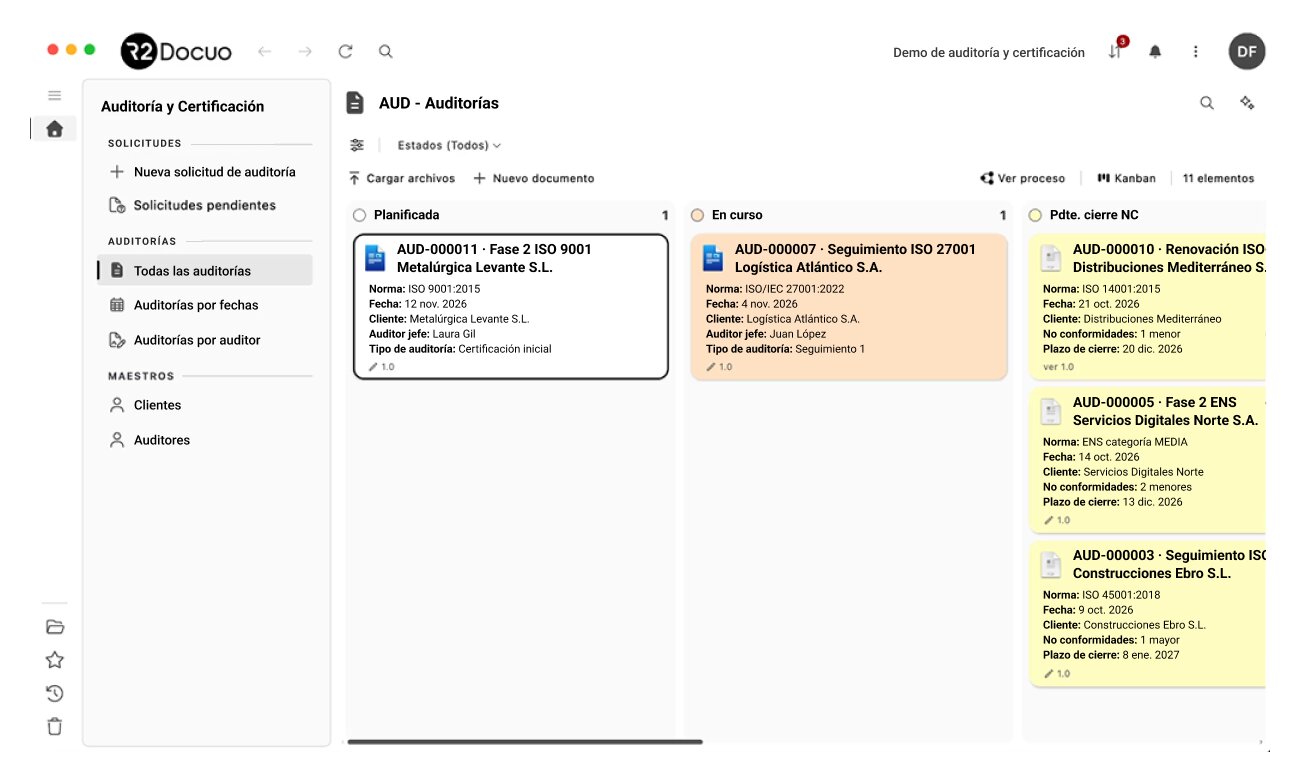
R2 Docuo is a Spanish document and process management platform, and its audit and certification software is built on that foundation. The practical difference from the specialised products on this list is the starting point: in R2 Docuo each client is a file holding everything the cycle produces (the quote, each audit with its plan and evidence, the reports and their versions, the nonconformities with their action plans, the certificates and the correspondence), and the process is drawn on top of that file with its statuses, owners and deadlines. In a certification body, much of the risk lies in the paperwork: a certificate issued from the wrong version of the report, or a piece of evidence left in someone’s inbox. That is where a document management platform is strongest.
The second strength is Spanish regulation. Bodies that audit public administrations, or that certify the National Security Framework (ENS) itself, are increasingly asked where they keep their clients’ information and with what guarantees. R2 Docuo is certified under the ENS at High category and hosts its Spanish clients’ data in Spain; none of the other vendors in this comparison publishes the ENS. The same platform runs inspection files with its export conformity verification software, a topic we cover in verification of conformity for exports.
On the other side of the table, the company being certified also needs its documentation in order for the audit; we explain how in document management for ISO audits and certifications.
Where it falls short: it is not a closed product for ISO/IEC 17021-1 with IAF MD 5 audit-day calculation or IAF MD 1 multi-site sampling out of the box: that logic is configured in the project, which is why pricing is custom rather than per certified client. We have no ranking in G2’s audit categories, and our reviews mention a learning curve once you get into the advanced configuration of fields and processes. Outside Spain and Latin America, Intact and Zertic have a stronger commercial presence.
2. TIC OS
- Best for: system, product and inspection certification bodies (ISO/IEC 17021-1, 17065 and 17020) that want a specialised, ready-to-use product with a known price.
- Price: €5 per certified client per month on the Standard plan, with discounts from 500 clients; the Advanced plan, with AI agents and integrations, on request.
- Reviews: G2 listing with no reviews · no Capterra listing.
- Security and data: the vendor, AuditOne (Germany), states ISO 27001 certification and EU hosting by default.
- Spanish: interface and client portal.
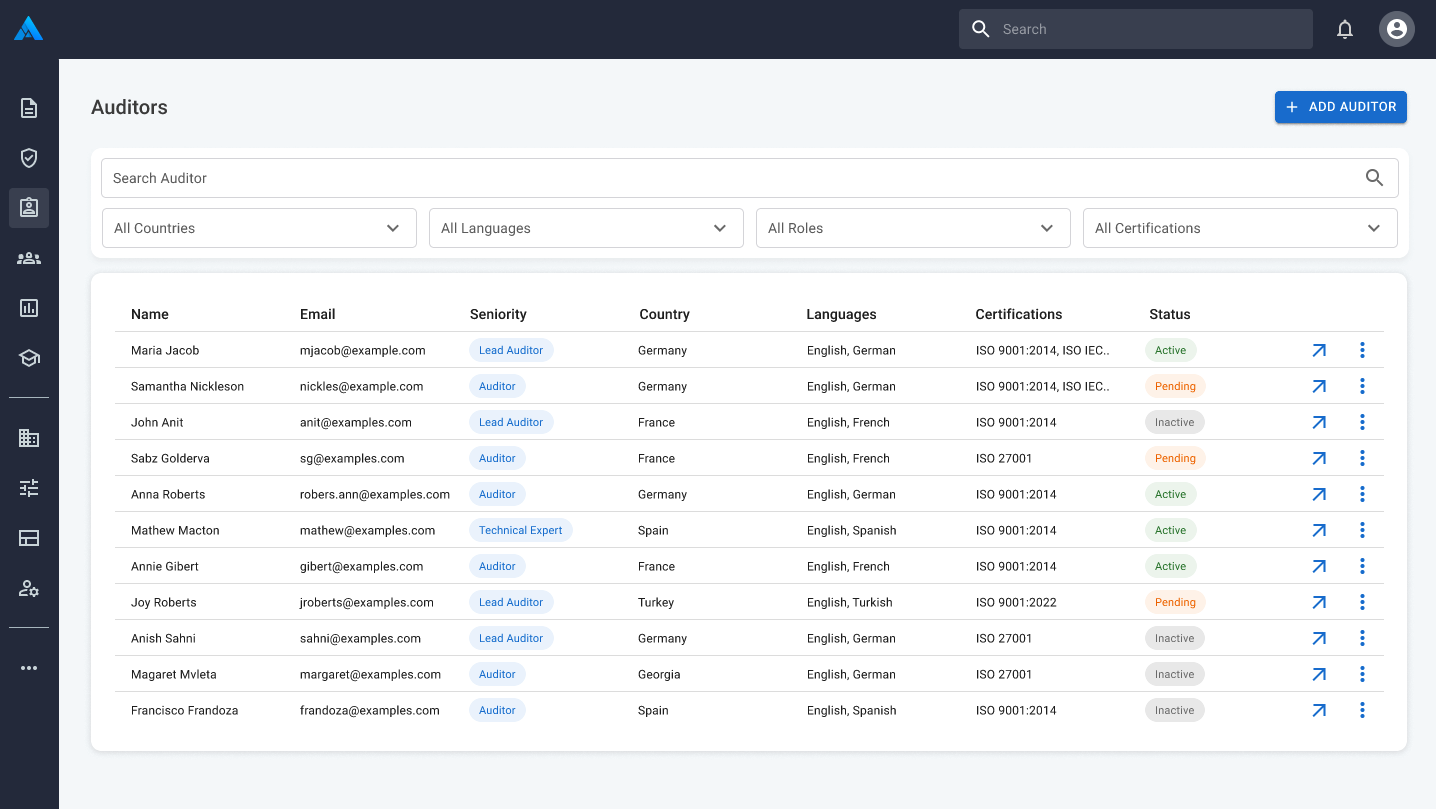
TIC OS, formerly ISO OS, is the product that publishes the most detail about the certification cycle: stages 1 and 2, surveillance, recertification and transfers; an auditor competence matrix with sector codes and conflict-of-interest control; audit-day calculation under IAF MD 5 and multi-site sampling under IAF MD 1; nonconformities with closure evidence; certificate issue, invoicing and a client portal accessed through a link, without a password. It is also the only one on the list that publishes a price, and in a unit that makes sense in this business: the certified client, not the user.
Where it falls short: it is a young product in the market (the vendor mentions more than 25 certification bodies as clients) with no public reviews to check real-world experience. It does not publish internal audit features or offline field work. And AuditOne is also a security audit company, which shows on its general website: go straight to the product page.
3. Zertic
- Best for: European certification, inspection and accreditation bodies looking for a specialised product with top-tier references.
- Price: no published pricing.
- Reviews: no reviews on G2 or Capterra.
- Security and data: states GDPR and ISO 27001 compliance; does not publish where data is hosted.
- Clients it shows: DEKRA · Kiwa · TÜV Nederland · Normec.
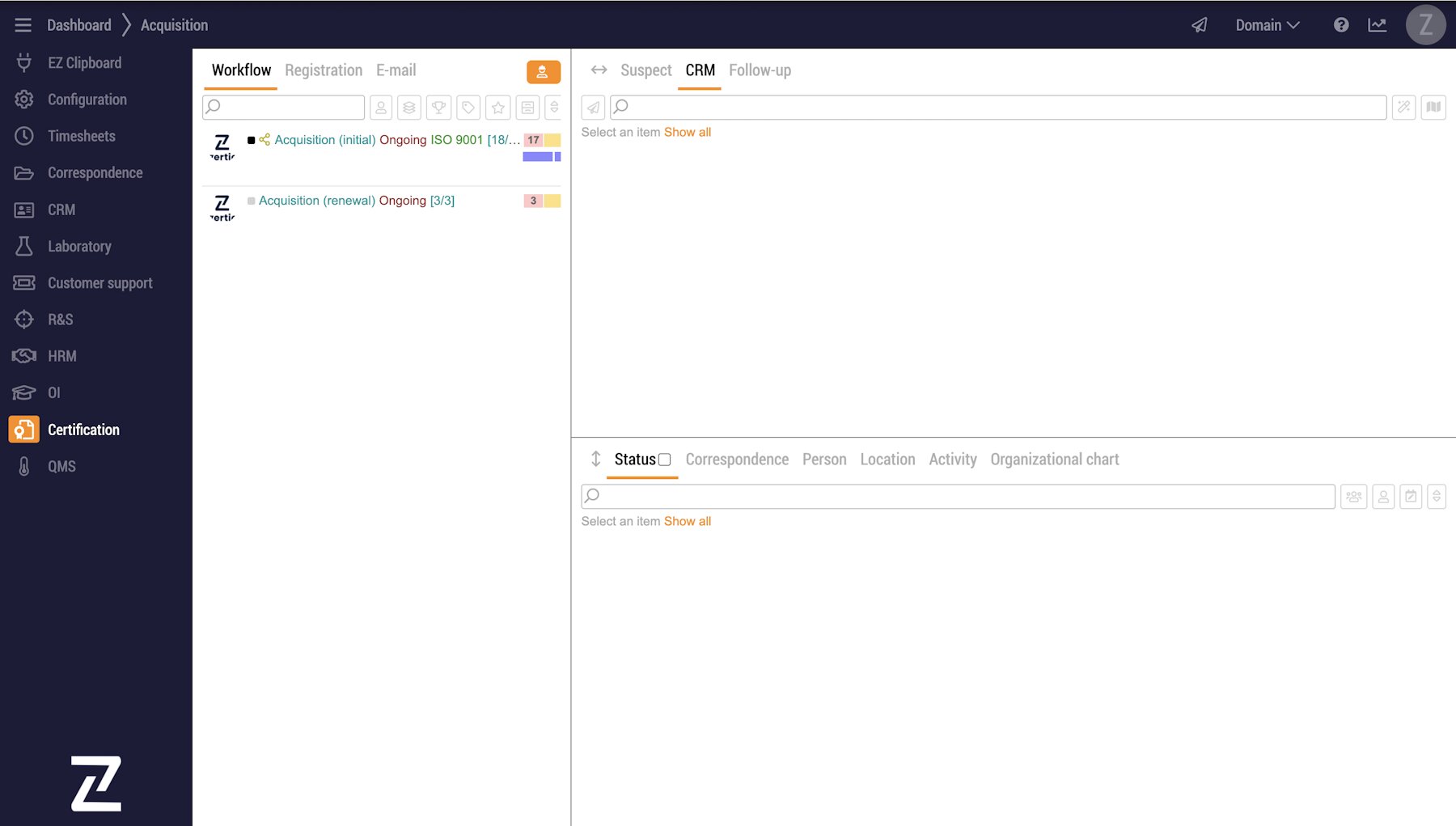
Zertic, from Eindhoven (Netherlands), is built for the body’s side: multi-year and multi-site audit programme, planning by auditor competence, nonconformity management, certification decision and client portal. Digital certificates are announced for a later phase. It is the tool AI assistants recommend most when asked about software for certification bodies, and its client portfolio, with several large certification groups, explains why.
Where it falls short: it publishes neither its price nor where data is stored, and with no reviews there is no way to check the user experience beyond its case studies. It does not publish offline field work either. Its website has a Spanish version, but the product targets the European market and shows no clients in Spain.
4. Intact
- Best for: international certification groups, certification scheme owners and accreditation bodies.
- Price: no published pricing.
- Reviews: G2 4.2/5 from 3 reviews · Capterra 3.5/5 from 2: too small a sample to draw conclusions.
- Security and data: does not publish certifications or hosting on its website.
- Clients it shows: Kiwa · TÜV NORD · Ecocert · MSC · Rainforest Alliance.
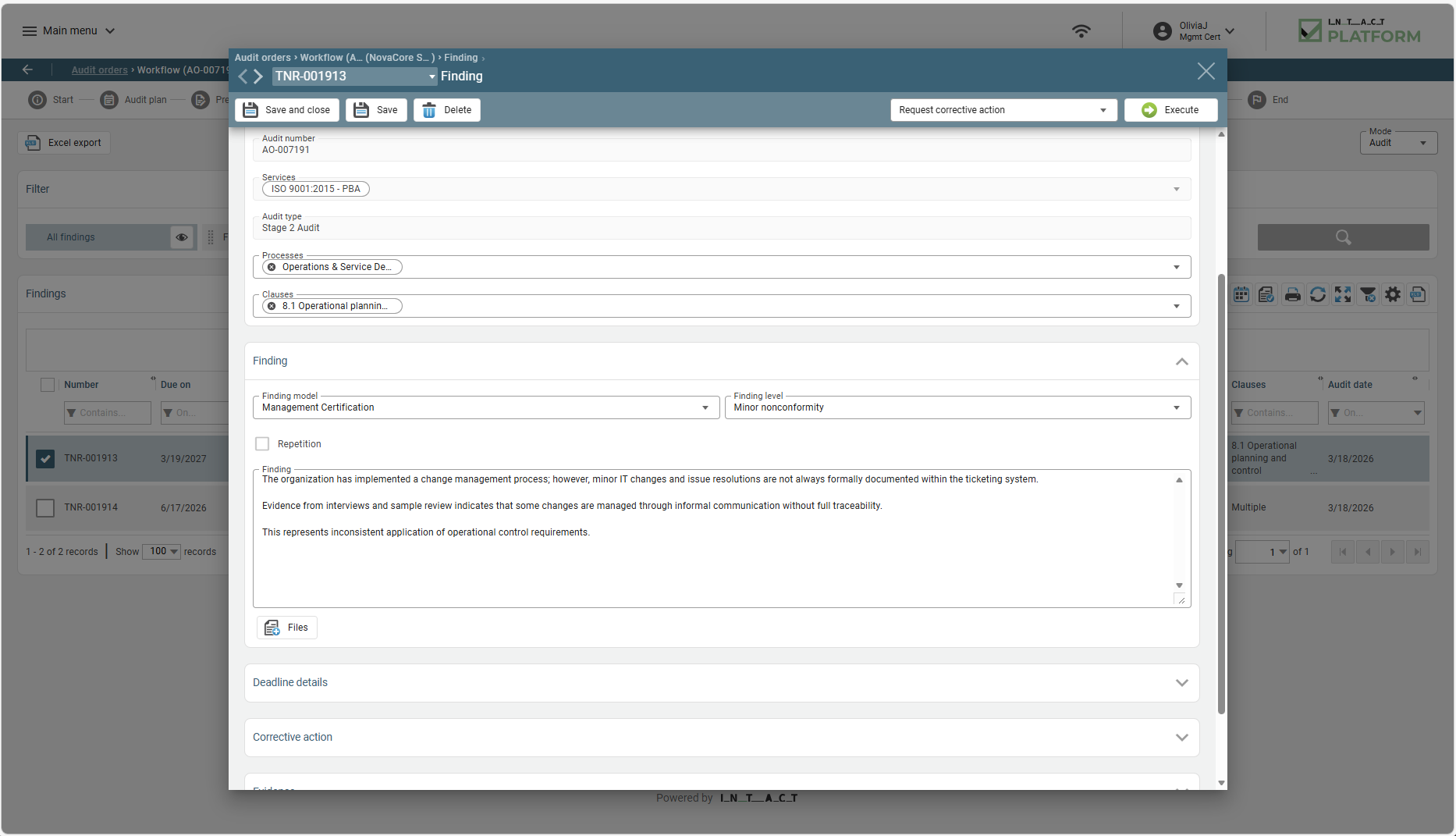
Intact, of Austrian origin, is the sector’s international reference: it says it operates in more than 160 countries and works with certification bodies, scheme owners (those who define a private standard and manage their auditor network) and accreditation bodies. It covers audit planning and execution, findings and configurable workflows, AI analytics and its own mobile app, Intact Mobile. Cloud or on-premises.
Where it falls short: its website is only in English and German and shows no clients in Spain, so support and implementation in Spanish need to be confirmed. It does not publish pricing, and its size and focus on large international networks make it heavier than necessary for a mid-sized national body.
5. CertiApp
- Best for: agri-food certification, designation-of-origin regulatory councils and inspection bodies in the sector.
- Price: no published pricing.
- Reviews: no listing on G2 or Capterra.
- Security and data: does not publish its own certifications or hosting.
- Clients it shows: Certifood · Certicar · OCE Global · CCL · Sinergis.
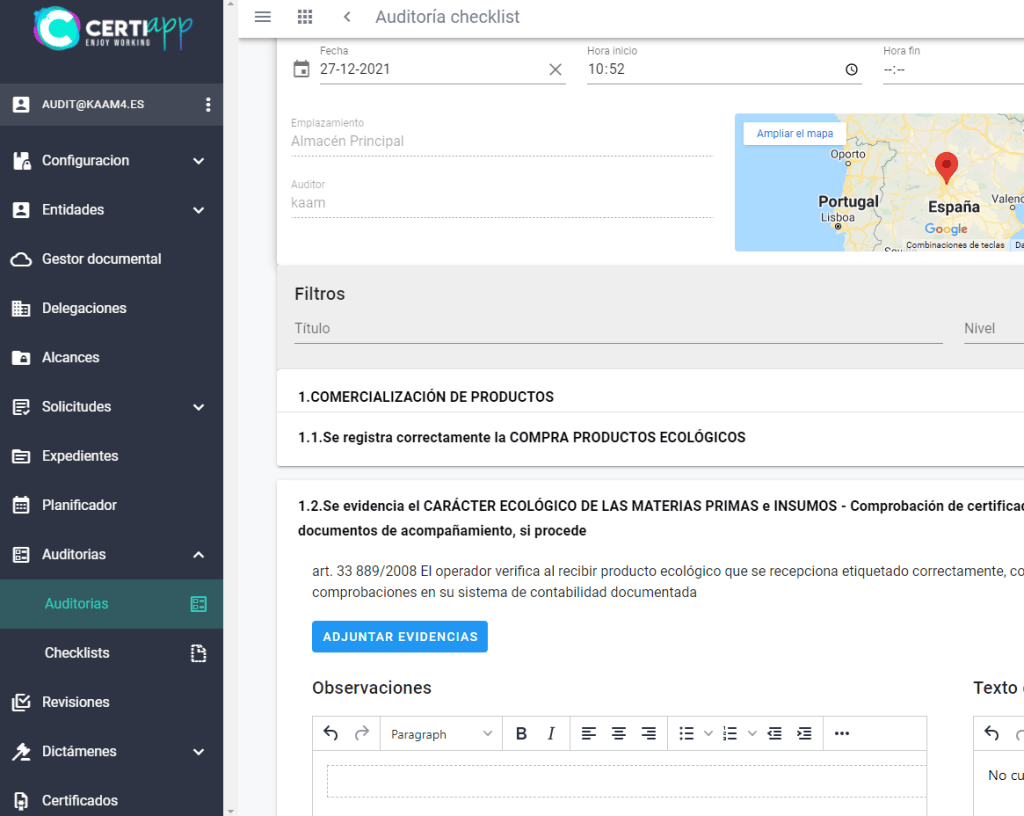
CertiApp is a Spanish product, from Albacete, linked to a company with more than twenty years of agri-food software, and has presented itself since 2015 as a solution for managing certification processes. Its mobile app works without coverage, which helps during an inspection in a field or a winery; it adds configurable checklists, an audit planner, tracking of each auditor’s performance, a client portal and document sending by email or WhatsApp. It connects to systems specific to the agri-food sector, such as the SICE and SIPEA registers or GLOBALG.A.P.
Where it falls short: outside agri-food it loses its edge. Its website does not mention nonconformity management, auditor assignment by competence or certificate issue, so ask for a demo of those three things. It does not publish pricing, security certifications or where it stores data either.
6. Selenne ERP for OCA
- Best for: authorised control bodies (OCA), technical control bodies, vehicle inspection stations (ITV) and non-destructive testing companies that want a single system for inspection and business management.
- Price: no published pricing; advertises a guaranteed fixed cost.
- Reviews: no reviews.
- Security and data: does not publish certifications or hosting.
- Clients it shows: ABC Inspecciones · Cerconca · Ingein · Iseval · Ispen · OCA Mallorca.
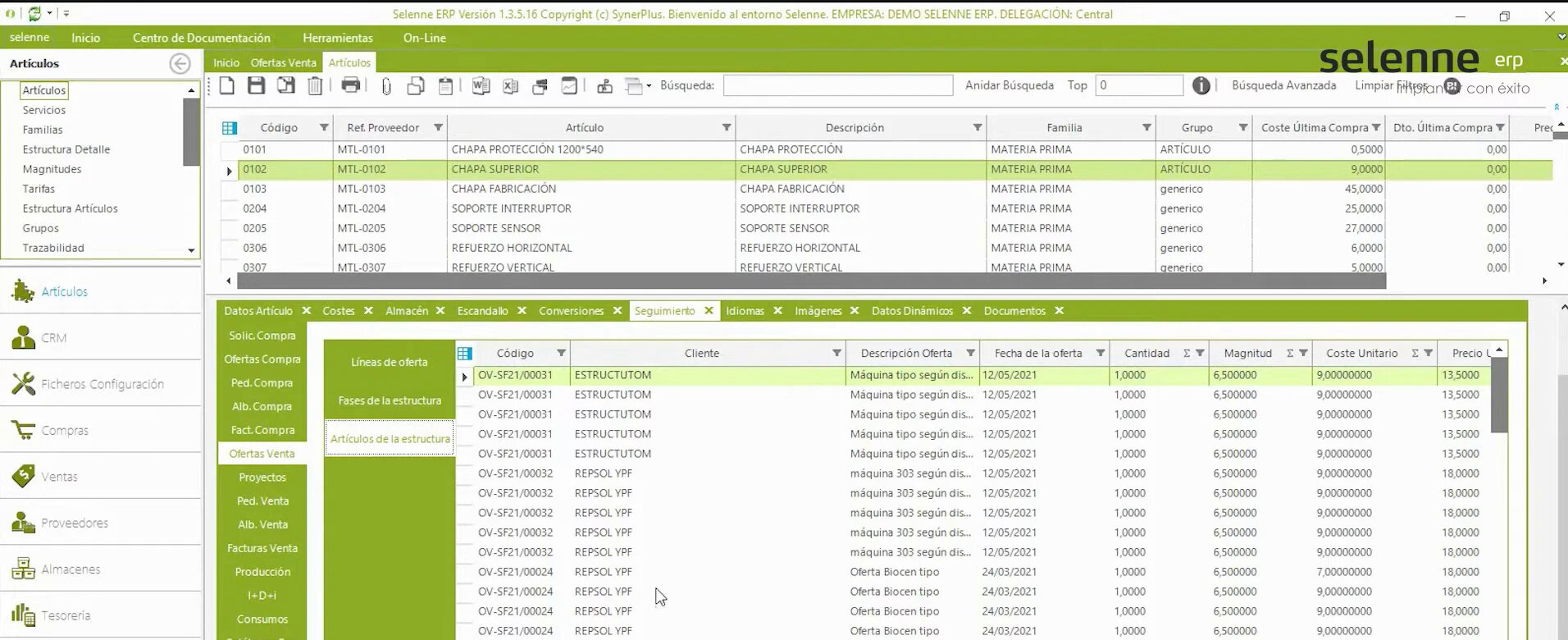
Selenne is an ERP with a version for control bodies that it says meets ENAC requirements: technician planning and assignment, inspections on tablet or mobile with synchronisation, reports and certificates with configurable formats, and everything an ERP includes as standard (quotes, invoicing, accounting). For an OCA currently working with several separate tools, having inspection and financial management in the same system is a real advantage.
Where it falls short: it is an ERP, not audit management software: it serves regulatory inspection (ISO/IEC 17020), not management system certification. Nonconformities sit in its quality module rather than in the inspection workflow, it does not publish a client portal or assignment by inspector qualification, and it has no public reviews.
How to choose audit management software: the 10 functions it must have
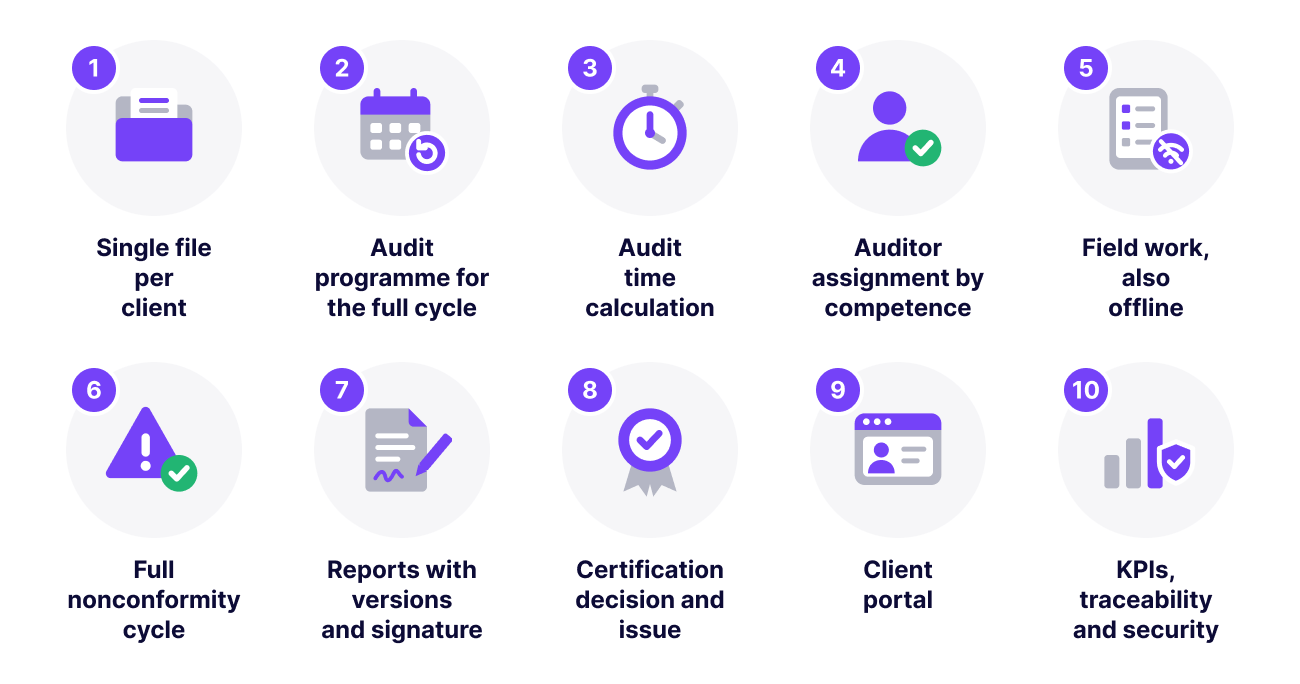
Feature lists tend to be generic. These ten come from what ISO/IEC 17021-1 requires of a certification body and from the failures that recur most when the cycle is run by hand. Ask to see each one with a real case, not a slide.
1. Single file per client
The whole cycle in one place: quote, application, plans, reports, evidence, nonconformities, certificates and correspondence. If answering a complaint means searching three inboxes, the system is not doing its job.
2. Full-cycle audit programme
The three-year calendar for each client (stages 1 and 2, surveillance and recertification) generated from the certification decision, with each audit’s window and an alert before it closes. It is the control that prevents the most trouble with the accreditation body.
3. Audit time calculation
Auditor days under IAF MD 5 based on the client’s effective headcount and complexity, with increases and reductions justified and recorded; and site sampling for multi-site clients (IAF MD 1).
4. Auditor assignment by competence
The system should only propose auditors qualified in the client’s standard and sector code, available and free of conflicts of interest, and warn when a qualification is about to expire before the next visit.
5. Field work, including offline
Checklists by standard, photos and evidence recorded on the spot from a phone or tablet, even with no coverage at the plant or in the field, and synchronisation on return.
6. Full nonconformity cycle
From the finding to its classification (major, minor or opportunity for improvement), the client’s action plan, the closure evidence and the verification of effectiveness, with an owner, a date and an alert at every step.
7. Versioned and signed reports
Reports and plans generated from audit data, with version control (who changed what and when) and the lead auditor’s e-signature. A certificate issued from the wrong report is a serious problem.
A certificate issued from the wrong version of the report is one of the costliest mistakes a certification body can make: it calls for version control and signature.
8. Certification decision and issue
Technical review and decision by someone who did not audit, certificate issue with its unique number, scope and dates, and management of extensions, reductions, suspensions, withdrawals and restorations.
9. Client portal
So the client can provide documentation, check its dates, send closure evidence and download its certificates without email chains.
10. KPIs, traceability and security
Audits carried out within their window, average nonconformity closure time, days between stage 2 and the decision, workload per auditor; a record of who did what and when; and role-based permissions over information that is confidential by definition.
Audit management software vs Excel, email and shared folders
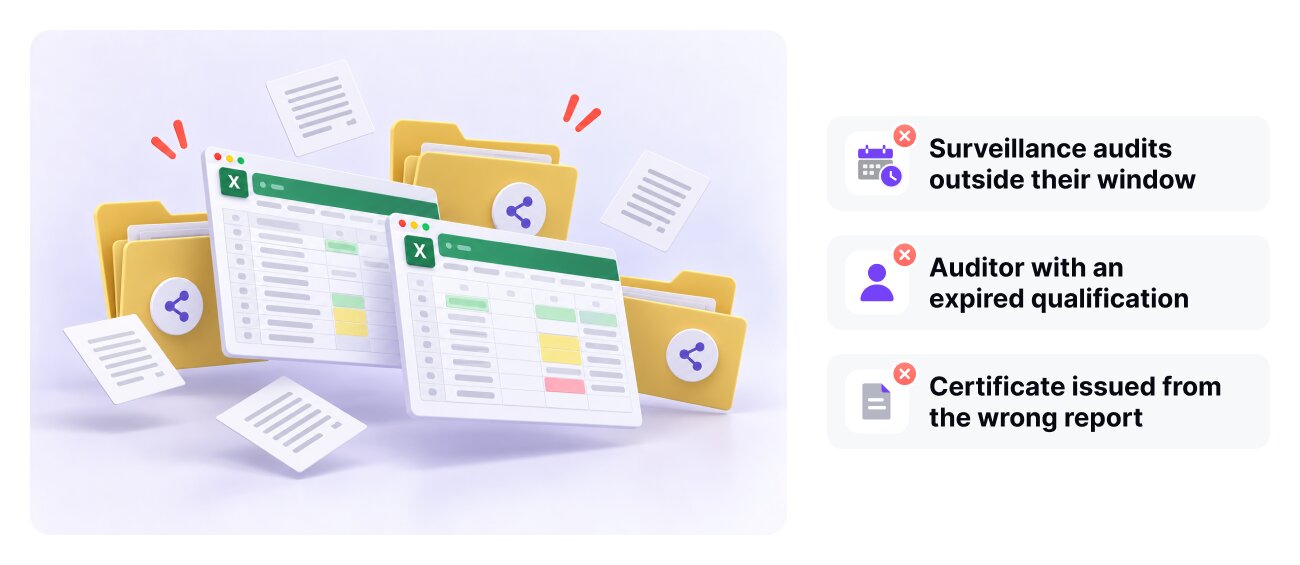
A small body, with a few dozen clients and two or three auditors, can run its programme in a well-built spreadsheet. Not everyone needs dedicated software from day one. The problem comes with volume, and always with the same symptoms:
- Surveillance audits that slip outside their window because nobody saw the date in time.
- Auditors assigned with an expired qualification or without the client’s sector code.
- Open nonconformities with no owner or date.
- Evidence scattered across inboxes, folders and personal drives.
- Certificates issued from the wrong version of the report.
- An accreditation body visit that forces you to rebuild a client’s history by hand.
If you recognise two or more, the spreadsheet is already costing you more than software. There is an in-between option that is not always considered: a document management platform with workflows, such as R2 Docuo, which handles the file, versions, signature and alerts without forcing you into the closed model of a specialised product. If your case is very standard and you want something ready to use, a specialised product such as TIC OS or Zertic is a better fit.
What Spanish regulations require of audit management software
No regulation forces a body to use a specific piece of software, but several shape how it must handle information, and that carries over to the tool:
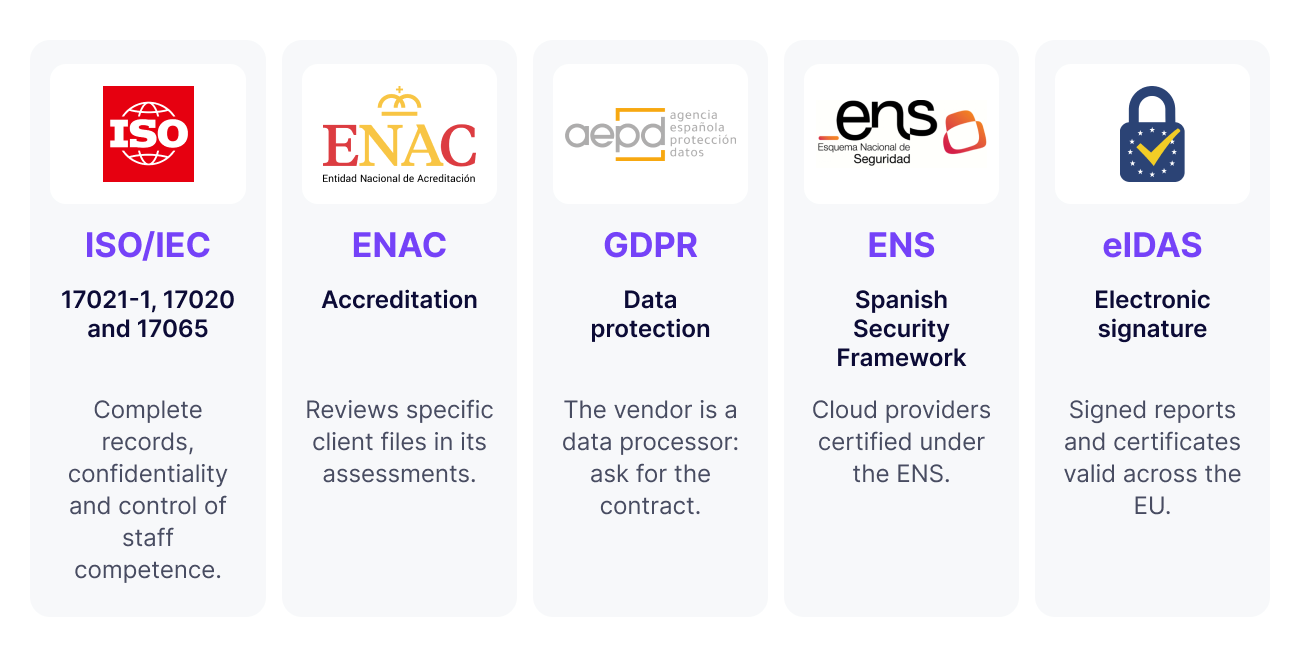
- ISO/IEC 17021-1, 17020 and 17065: require complete records for each client and each audit or inspection, confidentiality, separation between who audits and who decides, and control of staff competence. The software must leave a trail of all of it.
- ENAC: the Spanish accreditation body reviews specific client files in its assessments. Being able to show a client’s full cycle in minutes, with its versions, is the best proof that the system is under control.
- GDPR: the body processes personal data of its clients and of its own auditors. The software vendor is a data processor: ask for the contract and ask which country the data is in.
- National Security Framework (ENS): if your clients are public administrations or you certify the ENS, they will often ask that your cloud providers be ENS-certified, at a category matching the information they handle.
- eIDAS Regulation: the e-signature on reports and certificates must be valid throughout the EU; for documents with effects on third parties, an advanced or qualified signature is advisable.
Using audit management software from Claude, ChatGPT or Gemini
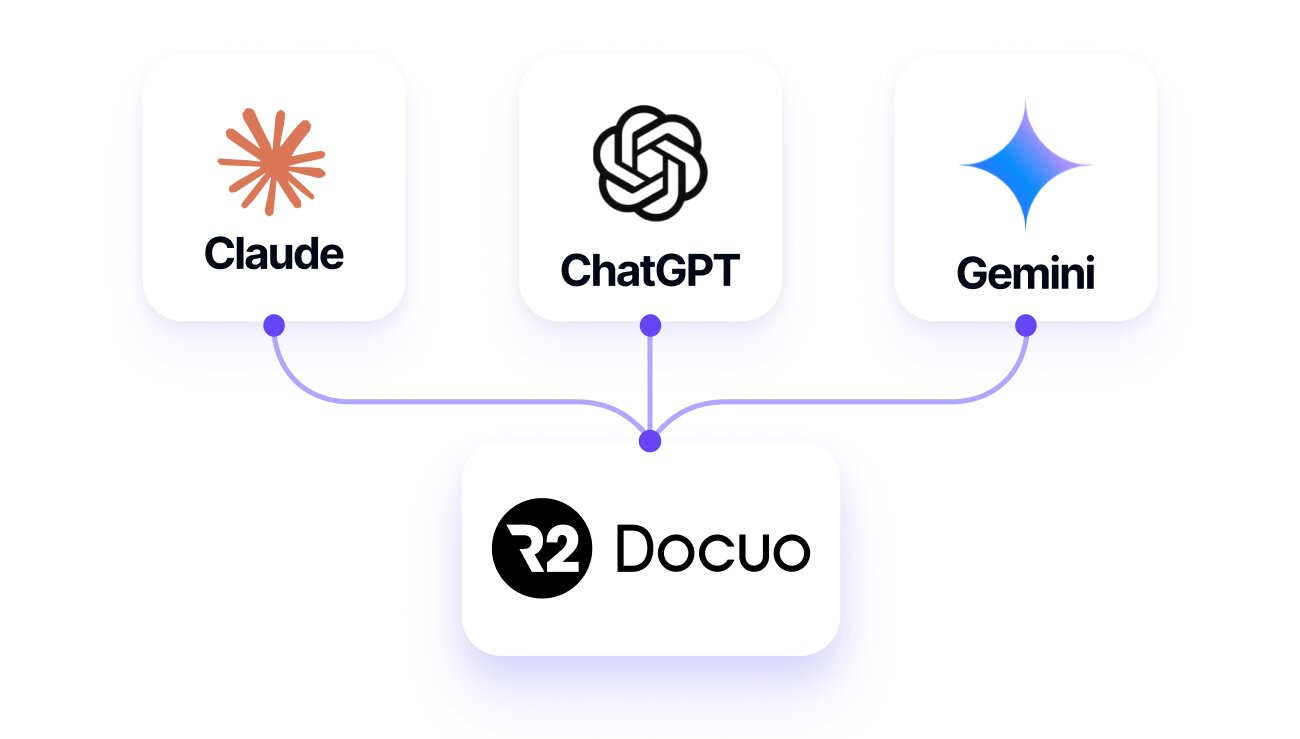
In 2026 the question is no longer whether a tool has AI, but whether your AI assistant can use the tool. The standard that makes it possible is MCP (Model Context Protocol): an MCP server lets Claude, ChatGPT or Gemini query and operate the application with the user’s permissions. R2 Docuo has an MCP server with 100% of its functionality, so you can ask the assistant which surveillance audits fall outside their window next month, which major nonconformities are still open or which auditor has a qualification about to expire, and trigger the action from there. TIC OS announces AI agents on its Advanced plan; the others publish nothing similar.
What matters now is not whether a tool has AI, but whether your assistant can use it with your permissions and without moving your data out of its region.
When comparing, ask four questions: whether the assistant only queries or also acts; whether it sees exactly what that user would see and nothing more; which plan includes it and at what price; and what information travels to the model provider and to which region. In a certification body, where everything is confidential, the last one matters most.
How much does audit management software cost in Spain?
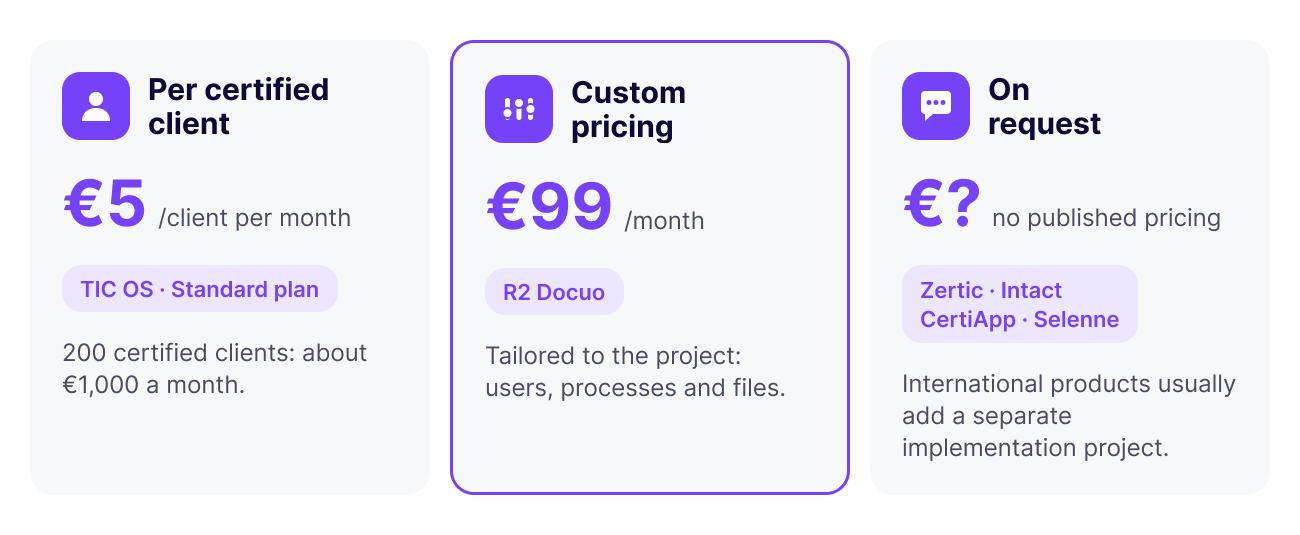
This market publishes few prices. Of the six tools, only two give a figure:
- Per certified client: TIC OS charges €5 per certified client per month on its Standard plan. A body with 200 certified clients would pay about €1,000 a month.
- Custom pricing from an entry fee: R2 Docuo starts at €99/month and adjusts the price to the project: number of users, processes and files.
- On request: Zertic, Intact, CertiApp and Selenne do not publish pricing. For international products aimed at large networks, expect a separate implementation project.
The useful question is not only how much it costs, but which cost it avoids. A surveillance audit outside its deadline can lead to the suspension of a client’s certificate, and an ENAC nonconformity for lack of programme control costs far more than any of these licences.
Frequently asked questions
It depends on the type of body. For certification and inspection in Spain, with heavy documentation, e-signature and security requirements such as the ENS, R2 Docuo is the only option in this comparison with ENS High category and data hosted in Spain. TIC OS and Zertic are specialised products for ISO/IEC 17021-1; Intact suits international groups; CertiApp, agri-food certification; and Selenne, control bodies.
There are three families: software built specifically for certification and inspection bodies (such as TIC OS, Zertic, Intact or CertiApp), document and process management platforms adapted to certification (such as R2 Docuo) and sector ERPs for control bodies (such as Selenne). Quality software for running a company’s own ISO system and financial audit software are other categories.
At a minimum: a file per client, an audit programme for the three-year cycle, audit time calculation, auditor assignment by competence, field work, the full nonconformity cycle, versioned and signed reports, certification decision and issue, a client portal and KPIs with traceability.
Because it is a small, specialised market, and because G2’s Audit Management category is designed for companies’ internal audit and excludes external certification audits. That is why G2 ratings are not useful for ranking this type of software.
With some tools, yes. CertiApp advertises a mobile app that works without coverage; others synchronise data when the connection returns. If you audit in plants, construction sites or farms, ask to see it working offline.
Few vendors publish it. TIC OS charges €5 per certified client per month on its Standard plan and R2 Docuo starts at €99/month with custom pricing. Zertic, Intact, CertiApp and Selenne work on request.
No. Financial audit software helps auditors review financial statements under auditing standards; audit management software organises the cycle of certification or inspection audits: planning, auditors, evidence, nonconformities and certificates.
If you have read this far, you already know which line of the list is yours. If it is the first one, R2 Docuo manages the audits of bodies such as SGS, Applus+ and TÜV SÜD, and you can see it working with a real file: ask for a demo and bring us a typical client.